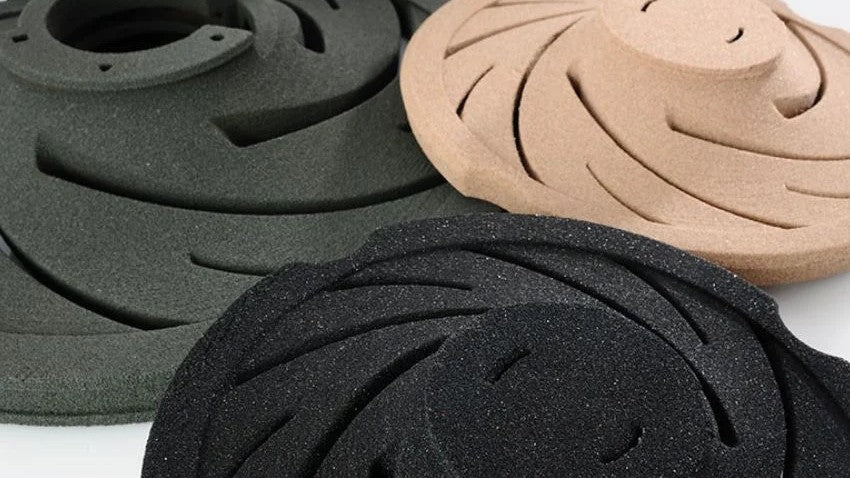
Eco Sand 3D Printing is a binder jetting process used to manufacture sand molds and cores directly from digital data. Instead of relying on conventional pattern tooling, the process builds tooling-free mold geometries layer by layer, which makes it attractive for complex castings, rapid development cycles, and lower-waste production workflows.
Process principle
The process starts with a CAD model of the casting or core. The geometry is sliced into layers, and a print head selectively deposits binder onto a thin layer of sand only where consolidation is required. The build cycle repeats until the full mold or core is completed, after which the printed part is cured, depowdered, and assembled for pouring.
This approach differs from conventional sand casting because it removes the need for many physical pattern-making steps. In practice, that means fewer setup dependencies, faster iteration, and more direct conversion from digital design to foundry-ready tooling.
Why it is technically important
Traditional sand casting depends heavily on patterns, core boxes, and manual preparation. Those steps introduce lead time, tooling cost, and design constraints, especially when a part contains internal channels, undercuts, or other complex features. Eco Sand 3D Printing reduces those constraints by producing the mold architecture directly from the digital file.
From a manufacturing perspective, the process also supports resource efficiency. Because the printer uses only the sand needed for the build and eliminates much of the physical tooling chain, the workflow can reduce waste, simplify storage, and cut down on logistics associated with traditional pattern production.
Key technical advantages
The technology offers several engineering benefits that make it attractive to foundries and product developers:
-
It supports complex internal geometries that are difficult or impossible to create with conventional tooling.
-
It shortens lead time by removing pattern fabrication and reducing pre-production setup.
-
It improves design flexibility because CAD revisions can be translated directly into new printed molds.
-
It can reduce material waste by limiting fabrication to the exact mold volume required.
-
It is well suited to low- and medium-volume production, where tooling amortization is less favorable.
These advantages make the process especially useful when speed, complexity, and iteration matter more than large-scale repetition.
Technical workflow
A typical workflow begins with digital model preparation. Engineers create the part geometry, then separate it into mold and core sections as needed for casting. The printer then deposits sand layer by layer, bonding each layer with a controlled binder application.
After printing, the mold is cured to develop handling strength. Loose sand is removed, and the mold sections are assembled before metal pouring. Because the process is additive, it can create forms that would require more elaborate core assembly or machining in a conventional workflow.
Applications in foundry work
Eco Sand 3D Printing is particularly useful in industries that rely on precision casting and repeated design changes. These include automotive, rail, energy, industrial equipment, and aerospace-adjacent manufacturing.
It is especially effective for:
-
Prototype castings.
-
Low-volume custom production.
-
Large parts with complex internal cavities.
-
Components that require frequent design updates.
-
Situations where tooling cost must be minimized.
For these use cases, the technology offers a practical bridge between digital engineering and physical casting.
Sustainability considerations
The “eco” aspect of Eco Sand 3D Printing is mainly about process efficiency rather than a single material claim. By reducing tooling needs, minimizing unnecessary material use, and enabling more targeted production, the workflow can lower environmental overhead compared with conventional casting preparation.
In addition, some process streams allow sand reuse or partial recycling, which further improves efficiency. While sustainability performance depends on binder chemistry, sand recovery, and production setup, additive sand printing is generally aligned with leaner manufacturing principles.
Technical limitations
Like any production method, Eco Sand 3D Printing has constraints. Binder jet sand molds must still be designed for structural stability, cure behavior, and post-processing handling. In practice, surface finish, dimensional accuracy, binder penetration, and depowdering all influence the final casting quality.
It is also not always the best choice for very high-volume, highly standardized parts, where traditional tooling may still be more economical. The strongest business case usually appears when complexity, customization, or time-to-market outweigh pure unit-cost optimization.
Conclusion
Eco Sand 3D Printing is a digital casting technology that combines binder jetting, additive manufacturing, and foundry engineering into one workflow. It replaces many traditional tooling steps, supports highly complex geometries, and can improve production efficiency while reducing waste.
For modern foundries, it is not just a new printing method; it is a manufacturing strategy for faster development, more flexible casting, and more sustainable production planning.


Leave a comment
This site is protected by hCaptcha and the hCaptcha Privacy Policy and Terms of Service apply.